When I first saw Richard Linklater’s Slacker (1990), not long after its release, I connected instantly to its vibe. In my early twenties, I was drawn to the margins, to nonconformity, to the unconventional, to meandering creativity, strange philosophizing, and the virtues of idleness. I still am. More than three decades on, the film remains funny and life-affirming, but it’s hard not to see something disturbing at its heart, as if, had we been able to see into the twenty-first century in the fin de siècle of the twentieth century, we would have glimpsed in Slacker a worrying future.
The counterculture in Slacker is atomized and sprawling. Anarchists, conspiracy theorists, artists, musicians, hustlers, drifters, idlers, dreamers, the mad, the criminal, and the café philosophers intersect without ever recognizing or seeking solidarity or community. The structure of Linklater’s film captures this atomization: across its succession of rapid, brief scenes, linked only by tenuous connections and absent a central thread, no character is on screen for more than a few minutes. Nobody dominates the film; equally, few encounters produce any lasting connection. Self-absorption—endearing and harmless—is the prevailing mood. A character appears, reveals their worldview—often to unwilling or disinterested or humouring listeners—and then just as quickly drifts back into city life. Slacker sometimes feels as if it presents Austin as a human zoo to be wandered through by the viewer.
Among its vast cast, a character speculates on alternative realities; another claims that NASA has been abducting children, has developed anti-gravity technology, and secretly landed on the Moon in the 1950s and on Mars in 1962; a passionate Kennedy assassination theorist discusses numerous concealed plots; an anarchist fantasizes about blowing up a government building; a graduate student takes his thesis committee hostage, believing that institutionalized learning is incapable of understanding his ideas; a man advocates giving away weapons for free to everyone. Scepticism about traditional media, anxiety about surveillance, and rejection of the establishment are recurring themes.
Although sharing a diverse unconventionality and common rejection of mainstream American values, Austin’s slackers rarely appear interested in seeding a movement. The few that do are limited by resources, the bizarreness of their ideas, and their inability to organize much more than getting out of bed. Thus, back in the early 1990s it seemed an absurd question, at odds with plausibility and the film’s atmosphere, to dwell on what it would look like if these misfits and dropouts ever moved from the margins towards the mainstream.
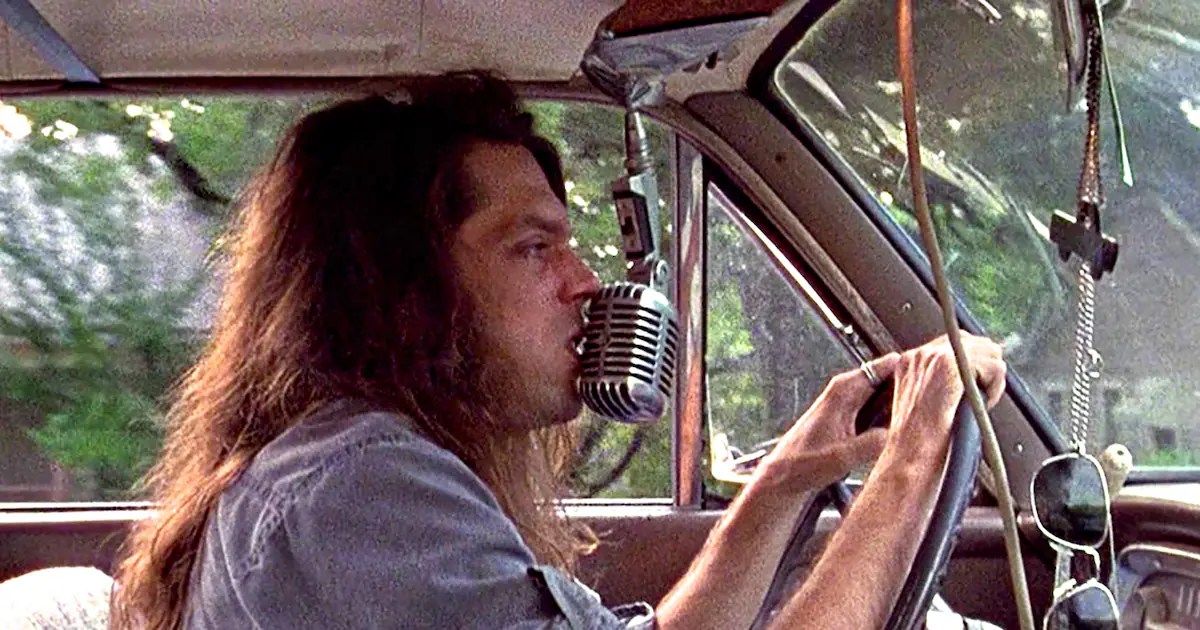
Yet we might be living the answer to that question. The uncomfortable realization, watching the film in a digital age of culture wars and Trumpism, is how many prominent figures in today’s politics of resentment and grievance would not seem entirely out of place in Linklater’s film. Slacker was one of the last films of the pre-Internet age; in many ways, it presents a final, innocent slice of a lost world. Its street and café philosophers and artists had no email or social media to communicate their beliefs: a music gig is promoted by word of mouth; a radical thinker drives around shouting his worldview through an in-car microphone; a conspiracy theorist is hoping to publish his book through a tiny independent press; the disgruntled graduate student sends a video to a television station where it gets ignored and dismissed; a woman hands out words of wisdom in the form of cards. There is an eagerness to be heard; but their voices reach only whatever Austinites happen to be present in the moment.
The amplification and rapid dissemination of beliefs enabled by the digital revolution does not in itself transform fringe worldviews into mainstream ones. But it creates larger and better-connected constituencies. The lone radical who had once hoped only to catch the ear of passers-by could now send out their message in an instant to a potentially global audience. The resulting constituencies could also catch the eye of new political movements keen to build a base. Above all, Trumpism has been unusually welcoming to some of the anti-establishment and conspiratorial currents running through Slacker.
There is no simple genealogy from Slacker’s counterculture to Trumpism, not least because Trumpism has proved capable of accommodating a multitude of sometimes conflicting beliefs and interests, even at the risk of ideological incoherence. The point is not whether many of these beliefs genuinely sit well with Trumpian politics; it is that Trumpism, in its quest to aggregate numerous constituencies, has offered them the semblance of a political home. By fracturing the boundary between mainstream and fringe beliefs, Trumpism has opened the door to fringe theorists and anti-establishment radicals. Demonstrably false claims and conspiracy theories once confined largely to the fringes are now voiced by people with substantial political influence and accepted by millions. QAnon, “Pizzagate”, and the “stolen” 2020 US presidential election are just some examples within a long roll call of claims unsupported or contradicted by evidence.
In Linklater’s Austin, a kind of firewall ensured the social and cultural marginality of the slackers, sometimes unfairly, sometimes thankfully; but in the Trumpian world and digital age, the border between fringe and mainstream has become much more porous. Marginality was a safety mechanism that allowed Slacker to be a comedy and to find charm even in the ridiculous and disturbing. Recent history shows us, however, that marginality might only be a very temporary state. That knowledge makes Slacker a different viewing experience today than it was in the early 1990s.
I still value idleness against relentless productivity; eccentricity against conformity; intellectual wandering against instrumental thought; scepticism towards institutions and authority; alternative ways of living; unconventionality and the anarchist spirit; the person who chooses to spend time discussing a metaphysical idea in a café rather than climbing the corporate hierarchy. But we should not assume that being outside the mainstream confers virtue. Perhaps all along we knew that some radical beliefs are dangerous, but we worried less about them because there seemed little realistic prospect of their escaping the margins.
Slacker remains a wonderful, endearing film. The margins it portrays are precious, and the freedom to think outside the mainstream is important. I am still drawn irresistibly to its slackers—if not to many of their individual beliefs, at least to the creative, free-thinking, and nonconformist atmosphere they generate. But my affection for them and for Slacker is now complicated by the knowledge that the margins do not always remain marginal.


Leave a comment