This piece contains spoilers for Walkabout.
The pleasant dullness of the opening montage—cars and office buildings, the busy legs of commuters, children in neat uniform at school, two of those children playing in a pool while their father looks on from a balcony—does not prepare the viewer for what follows. The father and children from the pool scene are sitting in a Beetle deep in the Australian outback. Incongruously—in one of the details that makes this scene and much of what follows dream-like—the children, a teenage girl and small boy, are in their school uniform, complete with satchels, as if the father had started on a school run but detoured into the wilderness. Even more strangely, though, the excursion appears planned: a prepared picnic is laid out by the girl while the boy plays among rocks and bushes and the father remains in the car reading about geology.
Then the father tries to murder his two children. Unsuccessful, he sets the car on fire before shooting himself in the head.
In this way, Nicolas Roeg’s Walkabout (1971) sets up the survival story of the rest of the film. Stranded and without skills—their names are never revealed, but their English nationality is, heightening the sense of them being ill equipped to be out of place—they nevertheless encounter no more than moderate peril. They find fruit and a waterhole, and when those resources are exhausted an Aboriginal boy shows up. He has been surviving alone in the bush as a rite of passage to adulthood (the “walkabout” of the film’s title, a colonial term that oversimplifies a range of Aboriginal practices). What follows is a fable—beautiful, often demanding, occasionally surreal—exploring themes of civilization, nature, rites of passage, sexuality, race, and communication.
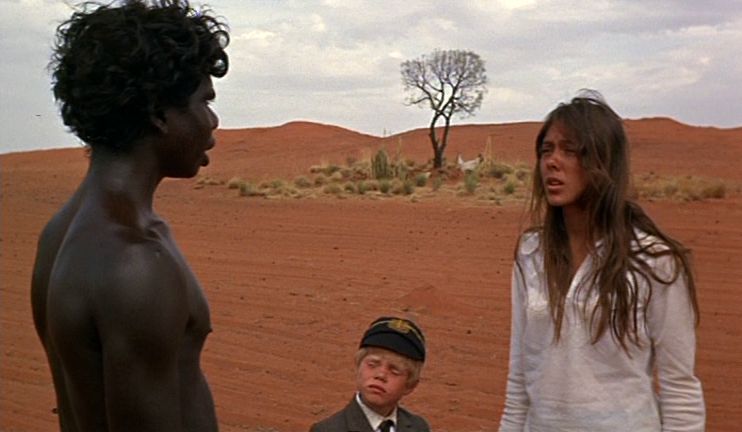
The violent opening suggests that civilization might be more perilous and harder to survive than wilderness. After surviving their father, the two white children are never in sustained danger. The Aboriginal boy shows them survival skills, he hunts for them, he guides them and looks after them. But the film dwells less on the practical challenges of survival and more on the inner worlds and interrelationships of the three protagonists. At its heart is an exploration of language and communication.
The Aboriginal boy speaks no English; the white children know nothing of the Aboriginal language. In their first encounter, the white children are in pressing need of water. The girl uses insistent and increasingly exasperated and loud repetition to express this need, but it is met with incomprehension. Her younger brother quickly improvises a more intelligent strategy: he gestures the act of drinking. The Aboriginal boy understands and shows them how to suck water from the earth. Over time, the two boys develop their sign language further until it becomes an efficient communication system that meets their basic needs. The girl, however, despite her sophisticated verbal language, manners, education, and social codes, never learns it, choosing instead to use her younger brother as an interpreter.
This refusal to learn the boys’ sign language might be taken as evidence of the girl’s sense of racial superiority, as might her quiet expectation that the Aboriginal boy provide unreciprocated assistance. But the girl Roeg presents is more complex than this. She is stoical—she shows little emotion at witnessing her father’s explosion of violence—caring and protective of her brother, naïve and innocent, kind towards the Aboriginal boy, and clumsily yet effectively practical. The survival experience forms her own rite of passage. Part of that is her burgeoning sexual awareness: she regards the Aboriginal boy with erotic curiosity but without ever acquiring any understanding of him as a person.
Her failure to understand or communicate—a failure that is less a choice and more the result of the social codes embedded in her—contributes to the tragedy that follows. After wandering through the bush, the three of them eventually come across an isolated, abandoned, and dilapidated homestead, where they settle into a rough domesticity. One day, the Aboriginal boy, adorned with elaborate face and body markings, dances a courtship ritual before the girl. Unable to read its meaning, she interprets this sexual invitation not as attempted courtship but as a threat. After a horrified rebuff of these advances, she informs her brother that they will leave the next day. Before departing, they find the Aboriginal boy hanging in a tree; once again, the girl sheds no tears.
It is striking that of the three children it is the Aboriginal boy who is the non-survivor. He alone is equipped with the skills to survive the wilderness, but he cannot survive the encounter with “civilized” white people.
But what has the girl learned? Early in their bush odyssey, before encountering the Aboriginal boy, the girl’s brother is upset about tearing his school blazer on a rock. She reassures him that it does not matter. At the end of their odyssey, as they prepare to re-enter civilization, she chides her younger brother on the state of his blazer, reminding him of the importance of presentability. Her wilderness experience appears only to have confirmed the social values and codes she held at its outset.
The final scene of the film occurs some years after the “walkabout”. The girl is now a young woman, married to a white man, living in an apartment in a middle-class high-rise that is identical to that in which she lived as a teenager. Her husband returns home with positive but uninteresting news of a career promotion. As they hug, she wistfully recalls the wilderness experience: she, her younger brother, and the Aboriginal boy are naked and happy, playing and swimming in a billabong. Nothing in the film suggests this is a memory; instead, her nostalgia is a fantasy of an Edenic paradise that never existed. In the fantasy, there is perfect communion between her and the Aboriginal boy; in the “reality” of the film, she never learned to communicate to survive the wilderness, because it turned out that she didn’t need to.
But perhaps she has learned another survival skill. Back in the pleasant dullness of civilization, she can survive it by remembering the wilderness not as the site of boundaries, violence, and exploitation, but as an Eden.
 J.S.Etienne
Leave a comment