Thinking, reading, writing, and the need for solitude

In 1913 Franz Kafka wrote the following to his fiancée, Felice Bower:

You said once that you would like to sit beside me while I write. Listen, in that case I could not write at all. For writing means revealing oneself to excess, that utmost of self-revelation and surrender… that is why one can never be alone enough when one writes, why there can never be enough silence around one when one writes, why even night is not night enough.*

Sara Maitland, in The Book of Silence, considers Kafka’s letter in the context of two different forms of, or reasons for seeking, solitude and silence: in her words, ‘the silence of the hermits and the silence of creative artists’. I instinctively think this distinction—although not one that entails an opposition or mutual incompatibility between its two sides—is correct.

When I reflect upon my own need for solitude I can understand how driven it is by the awareness that only in solitude can I feel fully and creatively alive. I do not have a strong need for a contemplative or spiritual solitude, the solitary life associated, for example, with the monk or the hermit. Certainly I find that being alone can be conducive to contemplation of ‘higher’ or ‘deeper’ things, such as beauty, or the divine, or the idea of transcendence, or the negation of the ego. But, for me, these are incidental to the real purpose of solitude (and, anyway, I am neither religious nor ‘spiritual’ in any meaningful sense).

The purpose is intellectual and creative. Without doubt I have learnt much in my life socially, through discussion and the sharing of ideas and knowledge, in the social settings of the classroom or the living room or the pub. Ultimately, however, truly deep learning only happens later, when, alone, I can reflect on what I have heard and said. And it is in that time of solitary learning that I need total concentration and immersion in thought. To be in company makes this impossible. It matters little if the company is quiet and undisturbing. For the simple possibility of disturbance, the mere presence of others, proves too much.

Just as I am unable to think truly and deeply in company, so too reading—the full engagement and mental interaction with a text—proves impossible. Even the library is not a place I find suitable to such deep reading (a problem that may explain the difficulties of my career as an academic researcher).

Similarly, like Kafka, I find that writing requires being fully alone. It demands a concentration of thought, and what Kafka termed a ‘revealing of oneself’, that are beyond reach in company. The social is an obstacle to true creativity. Writing as both a means to explore the world and a way of exploring and ‘revealing’ the self necessitates going deeply into one’s self—it requires solitude, at the very least a ‘room of one’s own’.

Since thinking, reading and writing are so central to my sense of self, I crave an abundance of solitude. It is only through solitude that I believe I can realize who I am. Of course, I’m conscious that there are other ways of understanding the ‘self’, and these doubtless apply to me too: that we are, in important and unavoidable ways, social beings, and that our ‘self’, or who we are, can never entirely be self-determined but results instead from a complex interaction between how we perceive ourselves and how others perceive us. And I’m aware that for many people self-realization is intrinsically, perhaps even exclusively, social. I do not claim that they are wrong to think so; I offer only a personal view on my own sense of self, and my consequent need for solitude.

Kafka never married.


*Kafka, Letter to Felice Bower, 14-15 February 1913, Letters to Felice, trans. James Stern (1973), as cited by Sara Maitland, The Book of Silence (London: Granta, 2008), pp. 190-1.
Solitude (II): The long way

I’ve been exploring writings on solitude and silence. Sara Maitland’s Book of Silence (2008) is a wonderful reflection on the subject, thoughtful, profound and based on extensive study of the literature and experience of silence. Among the examples she considers are the experiences of solo yachtsmen, for whom solitude and the silence that solitude brings are intense.

A notorious episode in the history of solo yachting was the 1968-9 Golden Globe race.* Around this time various sailors were progressing with plans to make the first non-stop solo circumnavigation of the world. Sponsored by the Sunday Times, the race was designed to award a prize to the first sailor to accomplish this achievement, with a further prize for the fastest time (since the competitors were setting off at different dates). Anyone embarking on such a voyage within the timescale was entered by default, whether they wished to compete or not, without any other qualification or eligibility criteria.

Nine sailors set out, but only one, Robin Knox-Johnston, returned. Several competitors were forced to retire, their boats or themselves unequal to the task; Nigel Tetley, who was trailing after Robin Knox-Johnston but was well placed to take the fastest time prize, was only a few days from finishing before his boat fell apart and he had to be rescued at sea. But the two most remarkable stories were those of Donald Crowhurst and Bernard Moitessier.

Crowhurst set out with limited experience in a boat that soon proved badly ill-suited to the challenge. He drifted around in the Atlantic before hatching an intricate plan to fake his log book and return to claim the fastest time prize. But the gradual realization that he would never get away with it (and perhaps guilt too at Tetley’s sinking, since Tetley had been pushing his boat hard to keep ahead of Crowhurst, supposing the latter to be in close contention for the prize) resulted in what appears to have been deep psychosis. Giving up entirely, he devoted his last few days at sea to writing a strange, deranged metaphysical treatise, before committing suicide by stepping into the ocean.**

Bernard_Moitessier_Golden_Globe

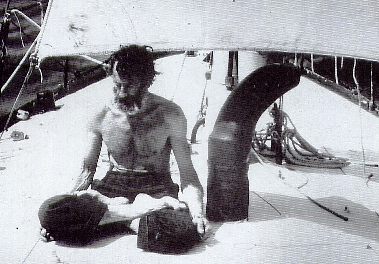
Moitessier, on his yacht Joshua, during his circumnavigation of the world

Moitessier was an experienced French sailor with a fine yacht; he was considered one of the favourites to win the fastest time prize. But he had had initial misgivings about the competitive nature of the race, and it was only with reluctance that he agreed to participate. He made solid progress towards the Cape of Good Hope; in the Indian Ocean his spirits were low, so he took up yoga to revive them; by the time he was past Australia and into the Pacific he was deeply in tune with the sea and increasingly reflective about the purpose of the voyage. It seems he was facing a kind of spiritual crisis, one that loomed ever larger as he closed in on Cape Horn. His dilemma was this: should he return to Plymouth to complete the race? Or should he keep going, past Good Hope again and on into the Indian and Pacific oceans to Tahiti or the Galapagos?

On 28 February 1969, by now in the Atlantic again, he wrote in his log that he was ‘giving up’—by which he meant that he was intending to complete the race. What he had decided to abandon was what he most wanted to do: to stay on the ocean where he felt happiest and most free, avoiding any return to European civilization. The next day, however, his spirits revived: he changed his mind and resolved to sail on. Shortly afterwards he wrote a letter to his publisher:

Dear Robert: The Horn was rounded February 5, and today is March 18. I am continuing non-stop towards the Pacific Islands because I am happy at sea, and perhaps also to save my soul.

And so Moitessier circumnavigated the globe, solo and non-stop, one and a half times, before eventually touching land once again, ten months after he had first set sail, in Tahiti.

Moitessier’s own account of his voyage, The Long Way (1971; English translation 1973), is a fine book. Engagingly written and appropriately exciting, it is also movingly reflective. It conveys the intense calm and joy that Moitessier felt on the ocean, his sense of connection to the sea, to the elements, to the seasons, to the birds, fish and dolphins that he encountered, his freedom, and his sense that he was in close contact with the beauty of life, the world and the universe. It also captures his acute dismay at the impoverished nature of ‘civilization’, its obsession with money and its destructive impact on the environment. To have returned to Europe, to western society and civilization, would have been to imperil his soul—the only way to save it, and to stay in touch with what was really important in life, was to sail as far away as he could.

The decision he took seems so right. I admire him for it—even to the point of envying his clarity and strength of purpose in following his heart. He turned away from the fame and wealth that could have been his (he signed away all royalties from his book to the Pope in the hope that the Church would take action to save the environment) because he was questing after something that transcends the superficial values and priorities that prevail throughout most of society. He comments that his wife and children would understand. They probably did. I understand.


* Peter Nichols, A Voyage for Madmen (2001) is an excellent account of the race.

** Nicholas Tomalin and Ron Hall, The Strange Last Voyage of Donald Crowhurst (2003) is a detailed account of Crowhurst’s participation in the race. In a subsequent twist, a couple of years later Tetley also killed himself, perhaps unable to adjust to life after the race.

Solitude (I)

‘Our language has wisely sensed… two sides of man’s being alone. It has created the word “loneliness” to express the pain of being alone. And it has created the word “solitude” to express the glory of being alone.’ (Paul Tillich, The Eternal Now, 1963)

remote_cottage

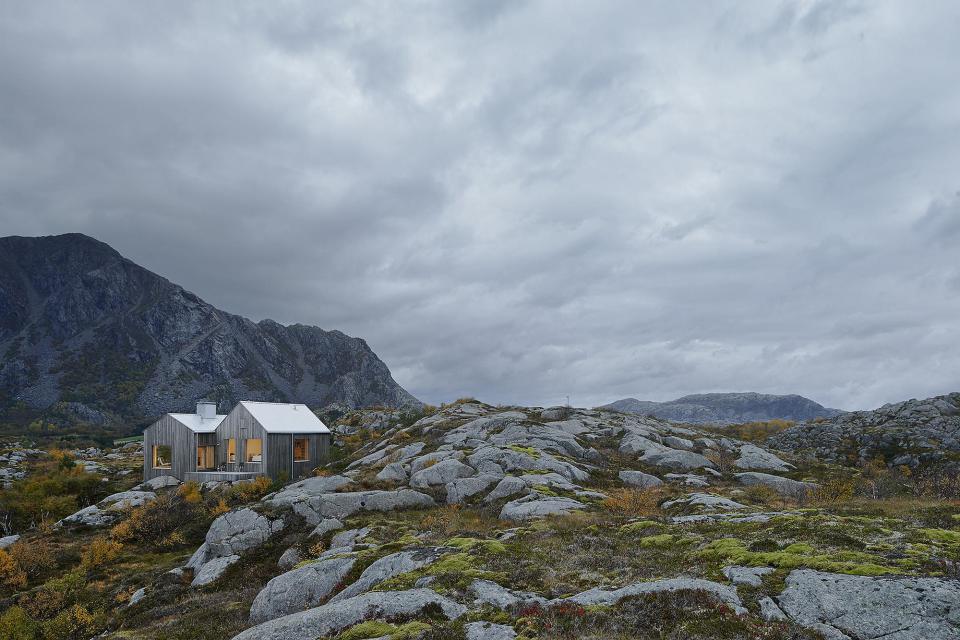
That looks very appealing…

I have a recurring fantasy of heading off somewhere remote to live alone, far removed from human society. The experience might well drive me to the psychological edge—perhaps even beyond it. But I am intrigued by the idea, by what I might learn about myself and about the universe.

Little of this fantasy is defined. Usually it consists of a simple dwelling, warm and cosy, filled with my books, surrounded perhaps by rolling hills, green views and some wild weather. All I need is warmth, shelter, a comfortable bed, basic facilities for washing and cooking, a means of writing, and my books and music. I can understand that not everyone would find that enough. But I struggle to grasp why anyone needs much more than that. Why all the gadgets, the spare rooms, the extra cars, the superfluous furniture, the stuffed wardrobes? Sometimes I wonder if my lack of desire for this abundance is at the root of my problems. I have never felt the need for all this, and so have never been inclined towards striving and ambition. But it’s clearly no good just living life in a simple way. Those of us who do not want to play the game of competition and ambition are forced to be part of it—but by not bothering to play, we lose.

So my fantasy is in part about wishing to escape the senseless game we find ourselves in. But it involves more than a negative opting out of society. Solitude, for me, is a positive choice. Even in my present life in the city I often willingly go for days without any human contact, not because I am antisocial but because I crave solitude. Others frequently interpret this as a rejection, but it really is no such thing. I genuinely enjoy my time with other people, but I can only manage it in small doses. I worry far more about the psychological damage of constant society than I do about the risks of constant solitude. To have plenty of time on my own—and I mean long stretches of days and days—is a deep need in me.

For how can we truly reflect if we are always immersed in the noises and demands of society? Of course there is much that we can learn only from other people—I have been a student and teacher, I have felt the value of discussion and the classroom, and many times the pub—but some things can only be accessed away from all that, by going deep into one’s self, by the solitary experience of the wilderness. Not everyone is curious about what might be learnt there; but for those of us who are, I cannot see any other way than through solitude.

So increasingly I feel the urge to figure out a way of doing this. Perhaps my reclusive tendency is a sign that I am already doing it. But I am not convinced that my current way of living is enough. Often I fall asleep imagining that I am nestled far away, where time and society no longer rule, where I would be undisturbed from reading, listening to music, walking, smoking, thinking and writing.

But for now I content myself with re-reading Sara Maitland’s A Book of Silence (2008), a wonderful exploration of silence and solitude (her 2014 book How to be Alone is also well worth reading), and, inspired by Maitland, Bernard Moitessier’s The Long Way (1973), a beautiful, frequently meditational, account of his solo sailing voyage around the world. As so often, books and reading fill the gaps in my life.