According to his own account, Descartes arrived at his philosophical breakthrough in a state of intense solitude. Heavy snow had confined him to a cabin, and it was there, with a few key props such as a fire and an armchair, that he followed his path of radical scepticism to its famous proposition of ‘I think therefore I am’, transforming philosophical inquiry for good.
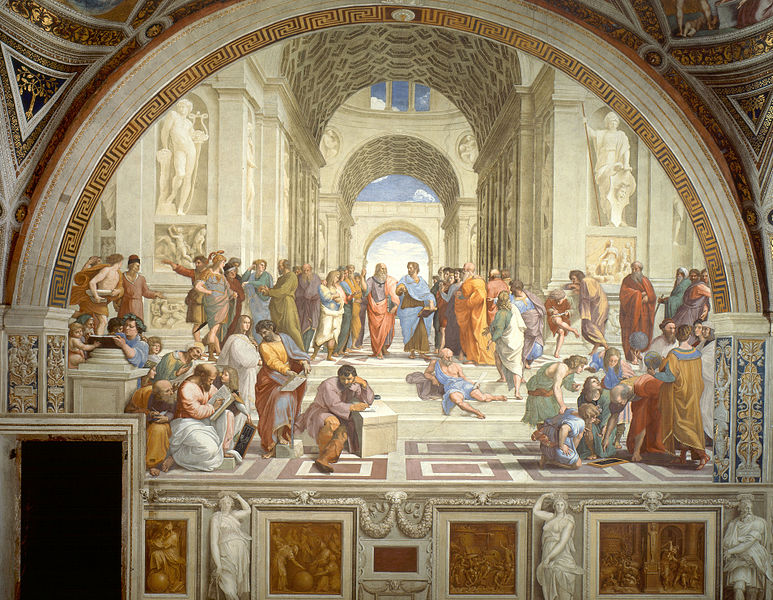
Raphael, The School of Athens, c.1510
Whatever its veracity, this story is profoundly interesting. Compare Descartes’ philosophizing with that of Socrates and Plato. Whereas the two ancient Athenians conducted their inquiries in a highly social way, through discussion, dialogue, a constant succession of questions and answers, Descartes eschews human company (indeed, his thought process involves him doubting that other humans even exist). Raphael’s famous painting of The School of Athens captures the buzzing, vibrantly social character of ancient Greek thought. Descartes’ Meditations could hardly be more different to this image: indeed, the very title of the work reflects the individualistic, meditational nature of Descartes’ philosophizing.
Historians of philosophy have long noted possible influences on Descartes’ approach. There are overtones of Augustine in various places—and hence we may speculate on resemblances with the meditational Confessions of the Church Father—and, more immediately, Descartes’ Jesuit schooling would have made him deeply familiar with the Spiritual Exercises of Loyola, a work stemming from Loyola’s own spiritual retreat. Perhaps, too, the spirituality of the late medieval devotio moderna, notably The Imitation of Christ by Thomas à Kempis (a work influential on Loyola’s spiritual conversion), may be identified as a precursor.
Descartes was certainly not exceptional in presenting a narrative of solitary, introspective, meditational thought. Indeed, he could be placed squarely within the spiritual tradition of Christianity, one that begins with the various stories of solitude and wilderness in the Bible, runs through the medieval mystical thinkers, and encompasses key religious figures as diverse as Loyola and Luther (whose famous theological breakthrough occurred, according to his own account, in his own state of reclusive confinement). The fact that the full title of Descartes’ Meditations states that the work proves the existence of God and the immortality of the soul suggests a conscious nod to this religious tradition, and perhaps even a wish that his treatise be placed within it.
Still, I think it significant that ‘modern philosophy’ (if we accept the common terminology of mainstream historiography of philosophy) should emerge out of a story of solitude. It is, of course, only a story, and it would be far too simple-minded to take it at face value—however much he liked to obscure its origins, Descartes’ philosophy arose from far more than the daily meditations of a solitary man in an armchair by a fire. But even if only a myth, like all myths it nevertheless asserts several ‘truths’: the value of the individual, the virtue of solitude, and the need to pursue understanding far from the crowd. These ‘truths’ are not uncontentious, and they do not necessarily have happy outcomes (individualism and solitude are not unalloyed goods). All the same, in an age in which those of us drawn towards introspection, solitude, quiet reflection and a refusal to conform to social conventions and norms are increasingly regarded with suspicion and even hostility, Descartes’ narrative of his own philosophical journey is reassuringly welcome.
And as we are urged and cajoled to rise early each day, to be busy and industrious in the world, we might note that Descartes’ practice was to lie in bed thinking until late in the morning. But even Descartes could not fully resist the demands of the world: accepting the position of court philosopher to Queen Christina of Sweden, he died only a few months after taking up the post, the rigours of rising in the very early hours to tutor the queen unsurprisingly taking their toll.
 j.s.etienne