Burnout (II)

My burnout, when it struck me with full force, can best be described as a disengagement from reality. I found myself incapable of opening up documents or checking my emails; I simply stopped work. None of it made sense to me anymore, and I began to recoil from anything related to work as if it represented a place of horror. Just as some use alcohol or drugs as a way of escaping reality and finding a happier place, so I found pleasant refuges in computer games, in random trawls of music videos, and in delirious fantasy while reclining on my sofa.

It was not, for the most part, a painful experience. Instead, it felt like—and, indeed, I convinced myself that I was having—an overdue, albeit unplanned, holiday. My sleep patterns remained terrible, my diet got worse, my isolation intensified, and mess accumulated around me, but I stopped caring. I was aware that my business and finances were collapsing fast, but I stopped caring about that too. Instead, I allowed myself simply to drift aimlessly through the days, seeking obscure pleasures, detached from the world outside my flat.

It occasionally crossed my mind that I should try to salvage my business and my livelihood. But the prospect of doing so took on ever more forbidding proportions, so I delved even deeper into my breakdown. I could no longer fathom what I had been doing for the previous two years; it made no sense and had no meaning. I had subjected myself to a grinding routine of laboriously going through, hour after hour, sentence after sentence, correcting syntax and punctuation, struggling to figure out meaning, and heroically trying to add some style to texts that rarely interested or inspired me. And in return I had been paid very little, I had no social life, no romance, and no time or energy to do anything that interested me.

There had been a time when my daily life had involved engaging with history, ideas, art and literature; but for the previous two years all those things had been replaced by an all-consuming attention to the minutiae of style and the scramble to pick up project after project just to squeak over the line that separated me from destitution and homelessness.

Nothing seemed worth salvaging. Instead, I concluded that I was better letting everything collapse, preserving my energy to rebuild from there, than spending my energy on trying to prevent the inevitable. For I had been aware for some time that my work and life were not sustainable in their present form; to have persisted with them, year after year, was going to destroy me mentally and physically. It was, therefore, better to allow the crisis to happen sooner rather than later, since to delay it would have been to lay the foundations for an even deeper crisis.

The reverie of my breakdown could not go on indefinitely. As I approached the critical point of no return, I became more frightened. Sometimes, I cried alone in my flat, grasping the disaster that was unfolding, unsure of what to do. I had stopped functioning in any normal way: I neglected my personal hygiene; I rarely left my flat and had barely any friends; and I felt increasingly ashamed of what was unfolding. I glimpsed some dark places: suicide seemed like an option, albeit an abstract one.

Ultimately, I located my safety net. It was my family. And I found, as I inched my way towards a more hopeful future, that some people showed me love and care. It was humbling.

My experience of burnout was both pleasant and horrible. It was the former because it involved a temporary escape from the stresses of work and scraping a living; it was the latter because it became scary, and because it took the form of a deep depression that made me wonder if I was going mad.

Yet, despite its unpleasantness, I see it as a form of salvation. It was necessary, because it forced me to find a way out of the life I had created. I had to take a break; I had to pause what I was doing and begin to reassess my priorities. I was caught in a seemingly interminable hell of grinding work just to pay my rent so I could continue with grinding work—and it seemed meaningless. My burnout, messy though it has been—and it has resulted in some radical and not altogether welcome changes in my life—has at least enabled me to rethink what I am doing with my life, and to search once again for meaning, fulfilment and pleasure.
Burnout (I)

Burnout was, for a long time, something that I neither understood nor sought to understand. I supposed it to be a phenomenon experienced by others and one that I would be immune to. Yet I sensed, about a year ago, that burnout was creeping up on me. My response was to imagine that I could power through and be superior to it. And then it overwhelmed me, devastating my business, finances and life.

I cast burnout as an outside force that knocked me over, because this is what it felt like. As I struggled with it, it seemed like a fight against an enemy determined to rip apart my life. In reality, however, the burnout was smouldering within me; and it was less an enemy, more a necessary salvation.

* * * * *

To understand my burnout, it is necessary to survey a brief history of my work. My background is in academia. After my first degree, I went on to study for an MA and a PhD. I then worked as a researcher on two large collaborative scholarly projects; I took on some part-time lecturing; and then I landed a full-time lecturing position on a rolling series of temporary contracts. The latter job was the best I have ever had: I loved every aspect of it and devoted myself to it fully. After four years, however, the funding ran out and I was made redundant. I was 44, an age that for many falls within the prime of their careers; yet I was jobless and my academic career was effectively over.

I floundered for a while, unsure of what to do. I tried to write; I took on some private tutoring. But nothing led to anything, my resources ran dry, and I found myself in a desperate state. So, about three years ago, with few options left, but knowing that editing is something I am good at, I set up my own editorial business.

In a modest way my business was a success. I managed, quite quickly, to accumulate clients and work. Within two or three months, I was earning enough to survive: I could pay my rent and bills, and I could just about eat. But to do this, I was working 60 to 70 hours per week. I was never able to take any substantial time off (I estimate that, including weekends and bank holidays, there were fewer than twenty days over the course of two years on which I did no work at all—once, I was even doing some editing on Christmas Day). My income never allowed me to have a social life or to date; and, anyway, I never had the time or energy to do such things. Nor did I have the time to read for pleasure: over the course of those two years, I did not read a single book, fiction or non-fiction, that I was not also editing.

I recognize, of course, that I may have made mistakes and that my work practices might have been better. But editing does not pay well, and I was trying to make a living as a single man renting a flat in London. I sensed that this was not sustainable in the long run and that I would have to rethink my work (and, indeed, my life as a whole), but my margins were so tight that all my time was spent scrambling to generate enough projects to pay my rent at the end of each month.

The first warning signs appeared about a year ago. I was experiencing increasing problems with my physical health: recurring headaches, low energy, intermittent chest pains, poor circulation, and constant bodily tension. My diet was terrible and my sleep patterns were worse; I was chain smoking, reliant on caffeine and sugar, and developing an unhealthy attachment to codeine. I sensed that a heart attack or stroke could happen at any time. Yet I did not care about the prospect of either, for my mental health was falling apart too. I recognized the onset of depression: lethargy, listlessness, joylessness, and a deepening sense that I was living a life without meaning or value.

My declining mental and physical health began to affect my work. Nevertheless, I ploughed on for several months, just about managing. And then, a couple of months ago, I had what was in effect a sudden and complete breakdown.

Revival

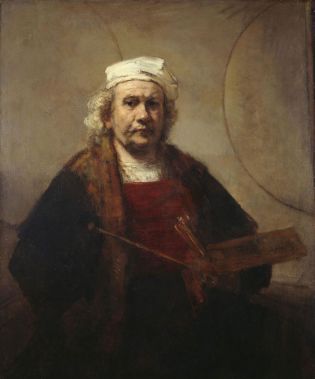
rembrandt self portrait

Rembrandt, Self-Portrait with Two Circles, 1665

I revive this blog in a state of deep personal crisis. My life has spiralled calamitously downwards, and I now find myself in the simultaneously frightening and exciting position of trying to soften the crash and build once again. I am, to use the familiar phrase, figuring out how I will get back on my feet again.

Up to a point, I want to write about this, possibly because it has therapeutic value for me, possibly because I think it may be of benefit to others, possibly because it is intrinsically interesting. There is not a clear idea in my mind why I want to document it, but then much writing comes from a place of unclear intentions. Writing, like reading, is a process of discovery.

My crisis is not, however, all I want to write about; indeed, I hope to keep it to a minimum. There are subjects and topics far more interesting than myself, even to me. I often reflect that it is unlikely to be coincidental that I am experiencing a personal crisis at the same time as we are all living through profound climate, political, social and cultural crises. And I am not so self-absorbed as to imagine that my own crisis comes remotely close in importance and urgency to these global crises; rather, I regard them as vastly more deserving of my time and attention. So, I wish to write about them, and about other things that interest me, far more than I wish to write about myself.

Nevertheless, we have to begin from somewhere. We live in an age in which the personal and the individual are valued, and hence are valid starting points for inquiries into life and the world around us. The key is to see them as places of departure from which we travel well beyond ourselves, rather than to be content never to escape the boundaries of our private concerns.

The best writing about the self—and, in so far as I will write about myself, the writing that inspires me the most—has always taken the individual as a point from which much broader, more universal thought may develop. I think of Montaigne’s Essays, the Confessions of Augustine and Rousseau, Proust’s In Search of Lost Time. Or, to take another creative genre, I think of Rembrandt’s magnificent series of self-portraits, works not of self-indulgence but of exploration of what it is to be human, to be alive and to face mortality.

If I could achieve even a fraction of the humanity and artistry of a writer such as Montaigne or an artist such as Rembrandt, then I would regard my life as making, in some small way, a positive contribution to the world.