‘Our language has wisely sensed… two sides of man’s being alone. It has created the word “loneliness” to express the pain of being alone. And it has created the word “solitude” to express the glory of being alone.’ (Paul Tillich, The Eternal Now, 1963)
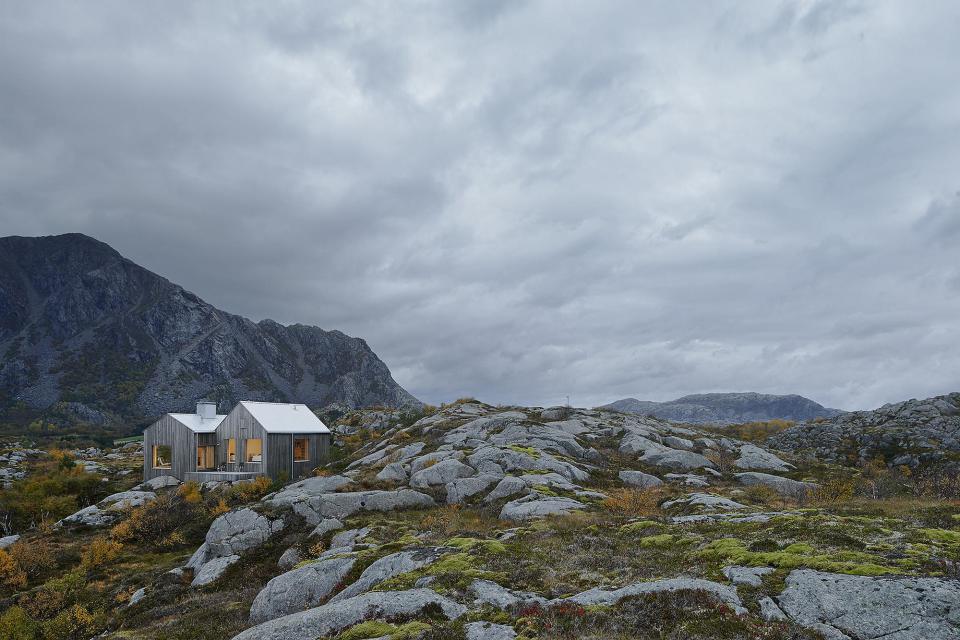
That looks very appealing…
I have a recurring fantasy of heading off somewhere remote to live alone, far removed from human society. The experience might well drive me to the psychological edge—perhaps even beyond it. But I am intrigued by the idea, by what I might learn about myself and about the universe.
Little of this fantasy is defined. Usually it consists of a simple dwelling, warm and cosy, filled with my books, surrounded perhaps by rolling hills, green views and some wild weather. All I need is warmth, shelter, a comfortable bed, basic facilities for washing and cooking, a means of writing, and my books and music. I can understand that not everyone would find that enough. But I struggle to grasp why anyone needs much more than that. Why all the gadgets, the spare rooms, the extra cars, the superfluous furniture, the stuffed wardrobes? Sometimes I wonder if my lack of desire for this abundance is at the root of my problems. I have never felt the need for all this, and so have never been inclined towards striving and ambition. But it’s clearly no good just living life in a simple way. Those of us who do not want to play the game of competition and ambition are forced to be part of it—but by not bothering to play, we lose.
So my fantasy is in part about wishing to escape the senseless game we find ourselves in. But it involves more than a negative opting out of society. Solitude, for me, is a positive choice. Even in my present life in the city I often willingly go for days without any human contact, not because I am antisocial but because I crave solitude. Others frequently interpret this as a rejection, but it really is no such thing. I genuinely enjoy my time with other people, but I can only manage it in small doses. I worry far more about the psychological damage of constant society than I do about the risks of constant solitude. To have plenty of time on my own—and I mean long stretches of days and days—is a deep need in me.
For how can we truly reflect if we are always immersed in the noises and demands of society? Of course there is much that we can learn only from other people—I have been a student and teacher, I have felt the value of discussion and the classroom, and many times the pub—but some things can only be accessed away from all that, by going deep into one’s self, by the solitary experience of the wilderness. Not everyone is curious about what might be learnt there; but for those of us who are, I cannot see any other way than through solitude.
So increasingly I feel the urge to figure out a way of doing this. Perhaps my reclusive tendency is a sign that I am already doing it. But I am not convinced that my current way of living is enough. Often I fall asleep imagining that I am nestled far away, where time and society no longer rule, where I would be undisturbed from reading, listening to music, walking, smoking, thinking and writing.
But for now I content myself with re-reading Sara Maitland’s A Book of Silence (2008), a wonderful exploration of silence and solitude (her 2014 book How to be Alone is also well worth reading), and, inspired by Maitland, Bernard Moitessier’s The Long Way (1973), a beautiful, frequently meditational, account of his solo sailing voyage around the world. As so often, books and reading fill the gaps in my life.
 j.s.etienne