I’ve been exploring writings on solitude and silence. Sara Maitland’s Book of Silence (2008) is a wonderful reflection on the subject, thoughtful, profound and based on extensive study of the literature and experience of silence. Among the examples she considers are the experiences of solo yachtsmen, for whom solitude and the silence that solitude brings are intense.
A notorious episode in the history of solo yachting was the 1968-9 Golden Globe race.* Around this time various sailors were progressing with plans to make the first non-stop solo circumnavigation of the world. Sponsored by the Sunday Times, the race was designed to award a prize to the first sailor to accomplish this achievement, with a further prize for the fastest time (since the competitors were setting off at different dates). Anyone embarking on such a voyage within the timescale was entered by default, whether they wished to compete or not, without any other qualification or eligibility criteria.
Nine sailors set out, but only one, Robin Knox-Johnston, returned. Several competitors were forced to retire, their boats or themselves unequal to the task; Nigel Tetley, who was trailing after Robin Knox-Johnston but was well placed to take the fastest time prize, was only a few days from finishing before his boat fell apart and he had to be rescued at sea. But the two most remarkable stories were those of Donald Crowhurst and Bernard Moitessier.
Crowhurst set out with limited experience in a boat that soon proved badly ill-suited to the challenge. He drifted around in the Atlantic before hatching an intricate plan to fake his log book and return to claim the fastest time prize. But the gradual realization that he would never get away with it (and perhaps guilt too at Tetley’s sinking, since Tetley had been pushing his boat hard to keep ahead of Crowhurst, supposing the latter to be in close contention for the prize) resulted in what appears to have been deep psychosis. Giving up entirely, he devoted his last few days at sea to writing a strange, deranged metaphysical treatise, before committing suicide by stepping into the ocean.**
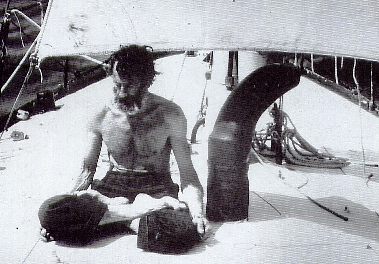
Moitessier, on his yacht Joshua, during his circumnavigation of the world
Moitessier was an experienced French sailor with a fine yacht; he was considered one of the favourites to win the fastest time prize. But he had had initial misgivings about the competitive nature of the race, and it was only with reluctance that he agreed to participate. He made solid progress towards the Cape of Good Hope; in the Indian Ocean his spirits were low, so he took up yoga to revive them; by the time he was past Australia and into the Pacific he was deeply in tune with the sea and increasingly reflective about the purpose of the voyage. It seems he was facing a kind of spiritual crisis, one that loomed ever larger as he closed in on Cape Horn. His dilemma was this: should he return to Plymouth to complete the race? Or should he keep going, past Good Hope again and on into the Indian and Pacific oceans to Tahiti or the Galapagos?
On 28 February 1969, by now in the Atlantic again, he wrote in his log that he was ‘giving up’—by which he meant that he was intending to complete the race. What he had decided to abandon was what he most wanted to do: to stay on the ocean where he felt happiest and most free, avoiding any return to European civilization. The next day, however, his spirits revived: he changed his mind and resolved to sail on. Shortly afterwards he wrote a letter to his publisher:
Dear Robert: The Horn was rounded February 5, and today is March 18. I am continuing non-stop towards the Pacific Islands because I am happy at sea, and perhaps also to save my soul.
And so Moitessier circumnavigated the globe, solo and non-stop, one and a half times, before eventually touching land once again, ten months after he had first set sail, in Tahiti.
Moitessier’s own account of his voyage, The Long Way (1971; English translation 1973), is a fine book. Engagingly written and appropriately exciting, it is also movingly reflective. It conveys the intense calm and joy that Moitessier felt on the ocean, his sense of connection to the sea, to the elements, to the seasons, to the birds, fish and dolphins that he encountered, his freedom, and his sense that he was in close contact with the beauty of life, the world and the universe. It also captures his acute dismay at the impoverished nature of ‘civilization’, its obsession with money and its destructive impact on the environment. To have returned to Europe, to western society and civilization, would have been to imperil his soul—the only way to save it, and to stay in touch with what was really important in life, was to sail as far away as he could.
The decision he took seems so right. I admire him for it—even to the point of envying his clarity and strength of purpose in following his heart. He turned away from the fame and wealth that could have been his (he signed away all royalties from his book to the Pope in the hope that the Church would take action to save the environment) because he was questing after something that transcends the superficial values and priorities that prevail throughout most of society. He comments that his wife and children would understand. They probably did. I understand.
* Peter Nichols, A Voyage for Madmen (2001) is an excellent account of the race.
** Nicholas Tomalin and Ron Hall, The Strange Last Voyage of Donald Crowhurst (2003) is a detailed account of Crowhurst’s participation in the race. In a subsequent twist, a couple of years later Tetley also killed himself, perhaps unable to adjust to life after the race.
 j.s.etienne