Is burnout depression by another name?

My experience of burnout involved disengaging from my work (and from reality in general). I lost the energy and will to continue doing something that I wasn’t much enjoying, that was taking up almost all my time, for which I was earning less than the minimum wage, and for which I did not feel valued. It felt like a defeat or a surrender: I gave up because the constant, all-consuming to succeed in the face of long odds against success no longer seemed worth it. To have continued would have risked more damage to my mental and physical health. (That makes it sound more a conscious decision than it was: I found myself giving up, rather than made a clear decision to give up.)

There is an evolutionary explanation of depression that is also about the value of giving up when confronted by overwhelming odds against success. Why stand and fight (for status, money, sex, pleasure, or anything else desirable) when to do so almost certainly risks defeat and potentially serious damage? Depression may be the body’s way of telling someone to retreat, to accept the futility of the struggle, and to hide away so as no longer to draw attention to oneself and risk further injury. Thus, depression may, at its core, be a sensible survival strategy: it makes no sense for a weakened individual to continue fighting when defeat is almost certain and quite likely catastrophic. Knowing when to rein in and suppress desires to avoid repeated disappointment and defeat would seem to be important.

That depression may have an evolutionary purpose does not mean that it works well in practice. To retreat and accept defeat may be the sensible responses that lie at the heart of depression; but clinical depression (at least as we understand it in the modern world) invariably involves an over-response in which our stress systems go into overdrive, often resulting in the inability to perform even basic functions. Thus, depression may make some evolutionary sense as a survival strategy, but it is one that is debilitating, excessive and highly imperfect. It is often rational to accept defeat in the pursuit of a goal; it is irrational to feel totally defeated in every area of one’s life.

Be that as it may, burnout seems to me very closely related to depression—and perhaps it is a variation of it. For burnout follows (as least as I have experienced it) not simply from overwork, but from the experience that no matter how hard one works, one’s goals (of success, of being valued, of enjoying work, of finding meaning and fulfilment, of earning enough to do more than scrape by) are never attained. And if we fail or are unable to pick up on and respond to the early signs of stress, then eventually we become overloaded by stress and breakdown occurs. Similarly, depression also seems to be a failure or inability (often through no fault of the individual) to prevent our stress system from going into overdrive.

In an earlier post on burnout I noted that my burnout felt oddly pleasurable: giving up felt like a release and liberation. I ought to qualify that: it was not so much pleasure as it was a temporary and somewhat illusory reduction in immediate stress. Overall, burnout is a horrible and destructive experience (which is not to say that it cannot ultimately lead to somewhere good). Likewise, depression is a horrible experience. But even with depression there is often a welcome feeling of release. Lying in bed rather than getting up and facing a stressful world can, for example, feel oddly pleasant and necessary, for in the short term it is an escape from or an avoidance of stress. Long term, of course, this is a debilitating and self-defeating response.

I regard neither burnout nor depression in a positive way. At the same time, I refuse to accept that they are wholly irrational and negative responses to a difficult situation. It may be right to consider them as illnesses; but perhaps our experience of them amounts to our endurance of our body and mind dealing with an underlying problem that needs addressing (much as the sickness we feel during a common cold derives from our body’s efforts to defeat the virus).

Above all, I am seeking to make sense of my burnout. And if burnout is a close cousin of, or even just a type of depression, then it would likely be something I can understand better and, more importantly, something that I can respond to more effectively.
Redundancy

Redundancy generally follows from one of two possible situations. In the first, an employee is informed that his or her role and duties are no longer required—that the roles and duties no longer have any value to an employer—and that the employee can bring no value to any other roles or duties in the organization. In the second, an employee is told that, although his or her roles still exist, other employees can do them at least as well or better. At the heart of both these situations, however, there is a single message being imparted to the employee in a redundancy process: you are no longer of value to this organization. To be told that one is no longer valued is likely to be a psychological shock, especially if an employee has formed an attachment with the organization and colleagues, and if the employee attributes a high value to his or her job.

I was made redundant five years ago from my position as a university lecturer specializing in cultural history and the history of ideas. It was the best job I had ever had. I loved everything about it: my teaching and administrative roles, the university I worked for, the colleagues I worked with, the students I taught. It was demanding, since I was on a teaching-only contract and had a heavy teaching load that invariably involved 60-hour working weeks, but I found the work meaningful, interesting and challenging (in a good way). I was part of a small department, and it was clear to me how I contributed to it; moreover, I felt valued by my colleagues and my students (justifiably, since I was dedicated to my work and good at it).

I had held this position for four years on a series of rolling short-term contracts. Technically, this meant that I had become a permanent lecturer. However, the funding for my post ran out, and my technical permanency offered me little protection. In a botched process, I was made redundant with a coldness that contrasted with the affection I had always felt towards my employers.

Thus, two weeks after my official redundancy meeting, I went from being someone who had a decent salary, a job title and position, meaningful and enjoyable work, colleagues, and status, to someone who had none of those things. I was 44 years old and should have been in the prime of my career; instead, I was jobless and my prospects of ever working in academia again were bleak. (And, apart from two colleagues who emailed me to wish me well, nobody marked my departure—there was not even a card. Several colleagues whom I had considered friends never contacted me again. My many students, on the other hand, were very generous in recording their dismay that I was leaving and their good wishes for my future.)

At the time, I barely reflected on this dramatic change, since I was preoccupied with various practicalities associated with the redundancy and my new situation. As I scrambled to claim benefits and figure out what I was going to do, I did not allow myself time to wonder about how little I was valued. Nor, at the time, did I allow myself to dwell on how a life and career I had long set my heart on was almost certainly over.

There is a twist in this tale: my role had not become redundant. Not long after I was made redundant the college advertised my position. I knew they would, and they expected me to apply (indeed, they hoped I would because they wanted me back). Yet they advertised largely the same role as a 0.7 position (rather than full time as it had previously been), for nine months, and with a one-week lead-in before teaching began (which would have required me to do a lot of preparation in my own time before the role officially commenced). At the same time, they advertised another position with a similar workload as a 1.0 for twelve months and with a six-week lead-in. I was shocked. And I recalled a colleague telling me that at a departmental meeting, at which the question of my possible return was discussed, the head of department had said: ‘What choice does he have? What else is he going to do?’

I decided I did have a choice: I could choose to maintain some self-respect and not allow myself to be messed around and undervalued. I did not apply, even though I knew that in not doing so I was almost certainly ending any faint chances of continuing my academic career.

The past five years have been a constant struggle. For most of that time I have had to focus on getting by from one month to the next. Survival received almost all my attention and diverted me from deeper distress about the bigger picture of my life. But I realize now how, lingering beneath the surface over these years, was a profound emptiness and loss. For that is what redundancy brings. In a society and culture in which high value is attached to employment, work, salary and status, the loss of all those things can be devastating. For me, the devastation has been insidious rather than sudden, but it has been no less powerful.

More particularly, redundancy can lead (as it has done in my case) to isolation, to a loss of self-worth, to frustration, and to a less meaningful life. I have worked as a freelancer since my redundancy, but I have earned less than a third of what I earned as a lecturer (while having to work even harder), and the work I have done has never come remotely close to providing me with the fulfilment and pleasure that my academic work gave me. In short, I have had to spend more hours doing significantly less enjoyable and meaningful things for a fraction of what I once earned, while unable to do anything I have wanted to do because of the all-consuming time and poor remuneration of my new work. Slowly but surely, the things I do have no longer seemed to hold value to me (which is also reflected in how poorly remunerated my work is); simultaneously, I have increasingly found it difficult to see my own value to society and the world.

There is also a sense of shame: to be unemployed, to be performing low-salaried work, to have no or low professional status, to be doing something that is little valued—sometimes these invite (unwanted) pity or sympathy, often they are shamed by our politicians, commentators, media, society and culture. I want to be loved and valued for who I am; too often, I feel rejected and shamed for my low salary and professional status.

Redundancy certainly cannot be blamed for all my struggles and problems over the last five years. Many people respond to redundancy by going on to better things. For some, redundancy may have been the best thing that happened to them. But this is not the case for me. I recognize now how badly it hit me and how I have yet to recover from it. All I had ever wanted was to be an academic and for my work to engage with and communicate ideas, history and culture. I am grateful that I managed to experience these things for a few years; but the loss resulting from redundancy looks ever more like a death, and I increasingly feel that, even now, I am in a grieving process.

Burnout (II)

My burnout, when it struck me with full force, can best be described as a disengagement from reality. I found myself incapable of opening up documents or checking my emails; I simply stopped work. None of it made sense to me anymore, and I began to recoil from anything related to work as if it represented a place of horror. Just as some use alcohol or drugs as a way of escaping reality and finding a happier place, so I found pleasant refuges in computer games, in random trawls of music videos, and in delirious fantasy while reclining on my sofa.

It was not, for the most part, a painful experience. Instead, it felt like—and, indeed, I convinced myself that I was having—an overdue, albeit unplanned, holiday. My sleep patterns remained terrible, my diet got worse, my isolation intensified, and mess accumulated around me, but I stopped caring. I was aware that my business and finances were collapsing fast, but I stopped caring about that too. Instead, I allowed myself simply to drift aimlessly through the days, seeking obscure pleasures, detached from the world outside my flat.

It occasionally crossed my mind that I should try to salvage my business and my livelihood. But the prospect of doing so took on ever more forbidding proportions, so I delved even deeper into my breakdown. I could no longer fathom what I had been doing for the previous two years; it made no sense and had no meaning. I had subjected myself to a grinding routine of laboriously going through, hour after hour, sentence after sentence, correcting syntax and punctuation, struggling to figure out meaning, and heroically trying to add some style to texts that rarely interested or inspired me. And in return I had been paid very little, I had no social life, no romance, and no time or energy to do anything that interested me.

There had been a time when my daily life had involved engaging with history, ideas, art and literature; but for the previous two years all those things had been replaced by an all-consuming attention to the minutiae of style and the scramble to pick up project after project just to squeak over the line that separated me from destitution and homelessness.

Nothing seemed worth salvaging. Instead, I concluded that I was better letting everything collapse, preserving my energy to rebuild from there, than spending my energy on trying to prevent the inevitable. For I had been aware for some time that my work and life were not sustainable in their present form; to have persisted with them, year after year, was going to destroy me mentally and physically. It was, therefore, better to allow the crisis to happen sooner rather than later, since to delay it would have been to lay the foundations for an even deeper crisis.

The reverie of my breakdown could not go on indefinitely. As I approached the critical point of no return, I became more frightened. Sometimes, I cried alone in my flat, grasping the disaster that was unfolding, unsure of what to do. I had stopped functioning in any normal way: I neglected my personal hygiene; I rarely left my flat and had barely any friends; and I felt increasingly ashamed of what was unfolding. I glimpsed some dark places: suicide seemed like an option, albeit an abstract one.

Ultimately, I located my safety net. It was my family. And I found, as I inched my way towards a more hopeful future, that some people showed me love and care. It was humbling.

My experience of burnout was both pleasant and horrible. It was the former because it involved a temporary escape from the stresses of work and scraping a living; it was the latter because it became scary, and because it took the form of a deep depression that made me wonder if I was going mad.

Yet, despite its unpleasantness, I see it as a form of salvation. It was necessary, because it forced me to find a way out of the life I had created. I had to take a break; I had to pause what I was doing and begin to reassess my priorities. I was caught in a seemingly interminable hell of grinding work just to pay my rent so I could continue with grinding work—and it seemed meaningless. My burnout, messy though it has been—and it has resulted in some radical and not altogether welcome changes in my life—has at least enabled me to rethink what I am doing with my life, and to search once again for meaning, fulfilment and pleasure.

Burnout (I)

Burnout was, for a long time, something that I neither understood nor sought to understand. I supposed it to be a phenomenon experienced by others and one that I would be immune to. Yet I sensed, about a year ago, that burnout was creeping up on me. My response was to imagine that I could power through and be superior to it. And then it overwhelmed me, devastating my business, finances and life.

I cast burnout as an outside force that knocked me over, because this is what it felt like. As I struggled with it, it seemed like a fight against an enemy determined to rip apart my life. In reality, however, the burnout was smouldering within me; and it was less an enemy, more a necessary salvation.

* * * * *

To understand my burnout, it is necessary to survey a brief history of my work. My background is in academia. After my first degree, I went on to study for an MA and a PhD. I then worked as a researcher on two large collaborative scholarly projects; I took on some part-time lecturing; and then I landed a full-time lecturing position on a rolling series of temporary contracts. The latter job was the best I have ever had: I loved every aspect of it and devoted myself to it fully. After four years, however, the funding ran out and I was made redundant. I was 44, an age that for many falls within the prime of their careers; yet I was jobless and my academic career was effectively over.

I floundered for a while, unsure of what to do. I tried to write; I took on some private tutoring. But nothing led to anything, my resources ran dry, and I found myself in a desperate state. So, about three years ago, with few options left, but knowing that editing is something I am good at, I set up my own editorial business.

In a modest way my business was a success. I managed, quite quickly, to accumulate clients and work. Within two or three months, I was earning enough to survive: I could pay my rent and bills, and I could just about eat. But to do this, I was working 60 to 70 hours per week. I was never able to take any substantial time off (I estimate that, including weekends and bank holidays, there were fewer than twenty days over the course of two years on which I did no work at all—once, I was even doing some editing on Christmas Day). My income never allowed me to have a social life or to date; and, anyway, I never had the time or energy to do such things. Nor did I have the time to read for pleasure: over the course of those two years, I did not read a single book, fiction or non-fiction, that I was not also editing.

I recognize, of course, that I may have made mistakes and that my work practices might have been better. But editing does not pay well, and I was trying to make a living as a single man renting a flat in London. I sensed that this was not sustainable in the long run and that I would have to rethink my work (and, indeed, my life as a whole), but my margins were so tight that all my time was spent scrambling to generate enough projects to pay my rent at the end of each month.

The first warning signs appeared about a year ago. I was experiencing increasing problems with my physical health: recurring headaches, low energy, intermittent chest pains, poor circulation, and constant bodily tension. My diet was terrible and my sleep patterns were worse; I was chain smoking, reliant on caffeine and sugar, and developing an unhealthy attachment to codeine. I sensed that a heart attack or stroke could happen at any time. Yet I did not care about the prospect of either, for my mental health was falling apart too. I recognized the onset of depression: lethargy, listlessness, joylessness, and a deepening sense that I was living a life without meaning or value.

My declining mental and physical health began to affect my work. Nevertheless, I ploughed on for several months, just about managing. And then, a couple of months ago, I had what was in effect a sudden and complete breakdown.

Revival

rembrandt self portrait

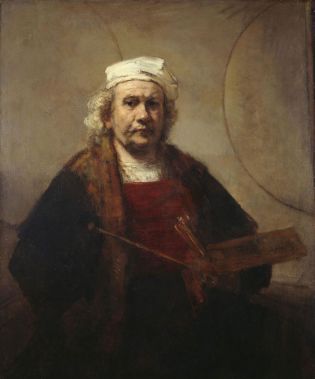
Rembrandt, Self-Portrait with Two Circles, 1665

I revive this blog in a state of deep personal crisis. My life has spiralled calamitously downwards, and I now find myself in the simultaneously frightening and exciting position of trying to soften the crash and build once again. I am, to use the familiar phrase, figuring out how I will get back on my feet again.

Up to a point, I want to write about this, possibly because it has therapeutic value for me, possibly because I think it may be of benefit to others, possibly because it is intrinsically interesting. There is not a clear idea in my mind why I want to document it, but then much writing comes from a place of unclear intentions. Writing, like reading, is a process of discovery.

My crisis is not, however, all I want to write about; indeed, I hope to keep it to a minimum. There are subjects and topics far more interesting than myself, even to me. I often reflect that it is unlikely to be coincidental that I am experiencing a personal crisis at the same time as we are all living through profound climate, political, social and cultural crises. And I am not so self-absorbed as to imagine that my own crisis comes remotely close in importance and urgency to these global crises; rather, I regard them as vastly more deserving of my time and attention. So, I wish to write about them, and about other things that interest me, far more than I wish to write about myself.

Nevertheless, we have to begin from somewhere. We live in an age in which the personal and the individual are valued, and hence are valid starting points for inquiries into life and the world around us. The key is to see them as places of departure from which we travel well beyond ourselves, rather than to be content never to escape the boundaries of our private concerns.

The best writing about the self—and, in so far as I will write about myself, the writing that inspires me the most—has always taken the individual as a point from which much broader, more universal thought may develop. I think of Montaigne’s Essays, the Confessions of Augustine and Rousseau, Proust’s In Search of Lost Time. Or, to take another creative genre, I think of Rembrandt’s magnificent series of self-portraits, works not of self-indulgence but of exploration of what it is to be human, to be alive and to face mortality.

If I could achieve even a fraction of the humanity and artistry of a writer such as Montaigne or an artist such as Rembrandt, then I would regard my life as making, in some small way, a positive contribution to the world.

Thinking, reading, writing, and the need for solitude

In 1913 Franz Kafka wrote the following to his fiancée, Felice Bower:

You said once that you would like to sit beside me while I write. Listen, in that case I could not write at all. For writing means revealing oneself to excess, that utmost of self-revelation and surrender… that is why one can never be alone enough when one writes, why there can never be enough silence around one when one writes, why even night is not night enough.*

Sara Maitland, in The Book of Silence, considers Kafka’s letter in the context of two different forms of, or reasons for seeking, solitude and silence: in her words, ‘the silence of the hermits and the silence of creative artists’. I instinctively think this distinction—although not one that entails an opposition or mutual incompatibility between its two sides—is correct.

When I reflect upon my own need for solitude I can understand how driven it is by the awareness that only in solitude can I feel fully and creatively alive. I do not have a strong need for a contemplative or spiritual solitude, the solitary life associated, for example, with the monk or the hermit. Certainly I find that being alone can be conducive to contemplation of ‘higher’ or ‘deeper’ things, such as beauty, or the divine, or the idea of transcendence, or the negation of the ego. But, for me, these are incidental to the real purpose of solitude (and, anyway, I am neither religious nor ‘spiritual’ in any meaningful sense).

The purpose is intellectual and creative. Without doubt I have learnt much in my life socially, through discussion and the sharing of ideas and knowledge, in the social settings of the classroom or the living room or the pub. Ultimately, however, truly deep learning only happens later, when, alone, I can reflect on what I have heard and said. And it is in that time of solitary learning that I need total concentration and immersion in thought. To be in company makes this impossible. It matters little if the company is quiet and undisturbing. For the simple possibility of disturbance, the mere presence of others, proves too much.

Just as I am unable to think truly and deeply in company, so too reading—the full engagement and mental interaction with a text—proves impossible. Even the library is not a place I find suitable to such deep reading (a problem that may explain the difficulties of my career as an academic researcher).

Similarly, like Kafka, I find that writing requires being fully alone. It demands a concentration of thought, and what Kafka termed a ‘revealing of oneself’, that are beyond reach in company. The social is an obstacle to true creativity. Writing as both a means to explore the world and a way of exploring and ‘revealing’ the self necessitates going deeply into one’s self—it requires solitude, at the very least a ‘room of one’s own’.

Since thinking, reading and writing are so central to my sense of self, I crave an abundance of solitude. It is only through solitude that I believe I can realize who I am. Of course, I’m conscious that there are other ways of understanding the ‘self’, and these doubtless apply to me too: that we are, in important and unavoidable ways, social beings, and that our ‘self’, or who we are, can never entirely be self-determined but results instead from a complex interaction between how we perceive ourselves and how others perceive us. And I’m aware that for many people self-realization is intrinsically, perhaps even exclusively, social. I do not claim that they are wrong to think so; I offer only a personal view on my own sense of self, and my consequent need for solitude.

Kafka never married.


*Kafka, Letter to Felice Bower, 14-15 February 1913, Letters to Felice, trans. James Stern (1973), as cited by Sara Maitland, The Book of Silence (London: Granta, 2008), pp. 190-1.

Solitude (II): The long way

I’ve been exploring writings on solitude and silence. Sara Maitland’s Book of Silence (2008) is a wonderful reflection on the subject, thoughtful, profound and based on extensive study of the literature and experience of silence. Among the examples she considers are the experiences of solo yachtsmen, for whom solitude and the silence that solitude brings are intense.

A notorious episode in the history of solo yachting was the 1968-9 Golden Globe race.* Around this time various sailors were progressing with plans to make the first non-stop solo circumnavigation of the world. Sponsored by the Sunday Times, the race was designed to award a prize to the first sailor to accomplish this achievement, with a further prize for the fastest time (since the competitors were setting off at different dates). Anyone embarking on such a voyage within the timescale was entered by default, whether they wished to compete or not, without any other qualification or eligibility criteria.

Nine sailors set out, but only one, Robin Knox-Johnston, returned. Several competitors were forced to retire, their boats or themselves unequal to the task; Nigel Tetley, who was trailing after Robin Knox-Johnston but was well placed to take the fastest time prize, was only a few days from finishing before his boat fell apart and he had to be rescued at sea. But the two most remarkable stories were those of Donald Crowhurst and Bernard Moitessier.

Crowhurst set out with limited experience in a boat that soon proved badly ill-suited to the challenge. He drifted around in the Atlantic before hatching an intricate plan to fake his log book and return to claim the fastest time prize. But the gradual realization that he would never get away with it (and perhaps guilt too at Tetley’s sinking, since Tetley had been pushing his boat hard to keep ahead of Crowhurst, supposing the latter to be in close contention for the prize) resulted in what appears to have been deep psychosis. Giving up entirely, he devoted his last few days at sea to writing a strange, deranged metaphysical treatise, before committing suicide by stepping into the ocean.**

Bernard_Moitessier_Golden_Globe

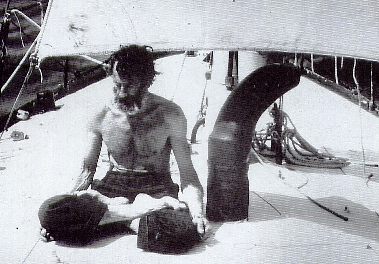
Moitessier, on his yacht Joshua, during his circumnavigation of the world

Moitessier was an experienced French sailor with a fine yacht; he was considered one of the favourites to win the fastest time prize. But he had had initial misgivings about the competitive nature of the race, and it was only with reluctance that he agreed to participate. He made solid progress towards the Cape of Good Hope; in the Indian Ocean his spirits were low, so he took up yoga to revive them; by the time he was past Australia and into the Pacific he was deeply in tune with the sea and increasingly reflective about the purpose of the voyage. It seems he was facing a kind of spiritual crisis, one that loomed ever larger as he closed in on Cape Horn. His dilemma was this: should he return to Plymouth to complete the race? Or should he keep going, past Good Hope again and on into the Indian and Pacific oceans to Tahiti or the Galapagos?

On 28 February 1969, by now in the Atlantic again, he wrote in his log that he was ‘giving up’—by which he meant that he was intending to complete the race. What he had decided to abandon was what he most wanted to do: to stay on the ocean where he felt happiest and most free, avoiding any return to European civilization. The next day, however, his spirits revived: he changed his mind and resolved to sail on. Shortly afterwards he wrote a letter to his publisher:

Dear Robert: The Horn was rounded February 5, and today is March 18. I am continuing non-stop towards the Pacific Islands because I am happy at sea, and perhaps also to save my soul.

And so Moitessier circumnavigated the globe, solo and non-stop, one and a half times, before eventually touching land once again, ten months after he had first set sail, in Tahiti.

Moitessier’s own account of his voyage, The Long Way (1971; English translation 1973), is a fine book. Engagingly written and appropriately exciting, it is also movingly reflective. It conveys the intense calm and joy that Moitessier felt on the ocean, his sense of connection to the sea, to the elements, to the seasons, to the birds, fish and dolphins that he encountered, his freedom, and his sense that he was in close contact with the beauty of life, the world and the universe. It also captures his acute dismay at the impoverished nature of ‘civilization’, its obsession with money and its destructive impact on the environment. To have returned to Europe, to western society and civilization, would have been to imperil his soul—the only way to save it, and to stay in touch with what was really important in life, was to sail as far away as he could.

The decision he took seems so right. I admire him for it—even to the point of envying his clarity and strength of purpose in following his heart. He turned away from the fame and wealth that could have been his (he signed away all royalties from his book to the Pope in the hope that the Church would take action to save the environment) because he was questing after something that transcends the superficial values and priorities that prevail throughout most of society. He comments that his wife and children would understand. They probably did. I understand.


* Peter Nichols, A Voyage for Madmen (2001) is an excellent account of the race.

** Nicholas Tomalin and Ron Hall, The Strange Last Voyage of Donald Crowhurst (2003) is a detailed account of Crowhurst’s participation in the race. In a subsequent twist, a couple of years later Tetley also killed himself, perhaps unable to adjust to life after the race.

On Descartes (II)

I have always found Descartes a problematic thinker. On the one hand I am drawn (as my previous post indicates) to his narrative of solitary philosophizing, as well as to the fine and clear arguments that are set out in his central works (the Discourse on Method and the Meditations), to how stimulating and suspiciously wrong they seem, and to the lucidity of his mechanical philosophy which conceives of the universe in terms of quantifiable matter and motion, surely the most useful and plausible way of understanding it. Yet, on the other hand, I cannot escape the feeling that Descartes represents a crucial point from which much of what is most dispiriting and downright wrong about the modern world stems. My reservations focus both on his purported philosophical method, and on the philosophy that resulted from it.

Descartes explicitly rejected the study of letters, and famously likened his philosophical approach to pulling down a building and rebuilding from the foundations up. Whatever the influences on his philosophy (and they are certainly there, from both ancient and medieval philosophy), his rhetorical strategy was to dismiss history and tradition as valueless and to emphasize the novelty and originality of his ideas. It is an undoubtedly seductive approach, and it is not hard to imagine its appeal: why be burdened with the laborious task of ploughing through complex, heavy philosophical tomes, when one can follow Descartes’ brilliantly simple and clear method and reasoning with a more certain guarantee of arriving at philosophical truth?

This approach has been hugely influential on modernity, to the extent that a cult of novelty and originality has followed in its wake. Of course, Descartes can hardly be held entirely responsible for this; nevertheless, as arguably the key figure in the emergence of ‘modern philosophy’, he can be regarded as one of the key contributors to this overvaluing of the new and the original. One of the consequences of this development is the undervaluing of history and the wisdom of the past. We relentlessly quest after new ideas and ways of thinking, and we contract our scope to the present and only very recent past.

Moreover, Descartes’ rarefied philosophical approach, one that consciously steered away from the world and towards the abstraction of reasoning of the mind, compounds the problems of a focus on novelty and originality. Descartes’ approach separates ideas from their social and historical reality, underscoring the philosophical concern (a highly fraught concern, in my view) with supposedly timeless truths.

In the sphere of economics, for example, current conventional thinking insists that markets are never wrong, that economies fail when a market is not fully free, that austerity is the correct response to budget deficits, and that a ‘shock doctrine’ needs to be applied to failing economies. Yet all of this is dogma based in large part on abstract reasoning rather than actual social and historical experience. It represents comparatively new ideas, supposedly at the cutting edge of economic thought, and it dismisses the value of studying alternative theories and the concrete reality of the past.

And there is another way in which the example of contemporary economic thought might be compared analogously with Descartes’ philosophy. One of the most striking aspects of the currently dominant economic theory is its presentation as a science: economics can be understood, according to this view, as a set of iron laws. What follows from this is an approach to economics in which the human, the irrational and the moral are absent. Focus is exclusively directed towards what is quantifiable and measurable. Hence, austerity and shock doctrines arise from a mentality in which the quantifiable is all that matters—the human suffering that results from these policies is of no concern, since suffering cannot be measured in the way that GDP can.

Descartes’ mechanical philosophy (one that also owed much to many other thinkers of the period, notably Galileo and Hobbes) involved a radical shift from viewing the universe in terms of qualities to understanding it as something essentially measurable and quantifiable. It is the basis of modern science. The importance of this intellectual achievement is beyond question; as I suggest above, the mechanistic view is both more plausible and more useful than what came before.

quantifying_happiness

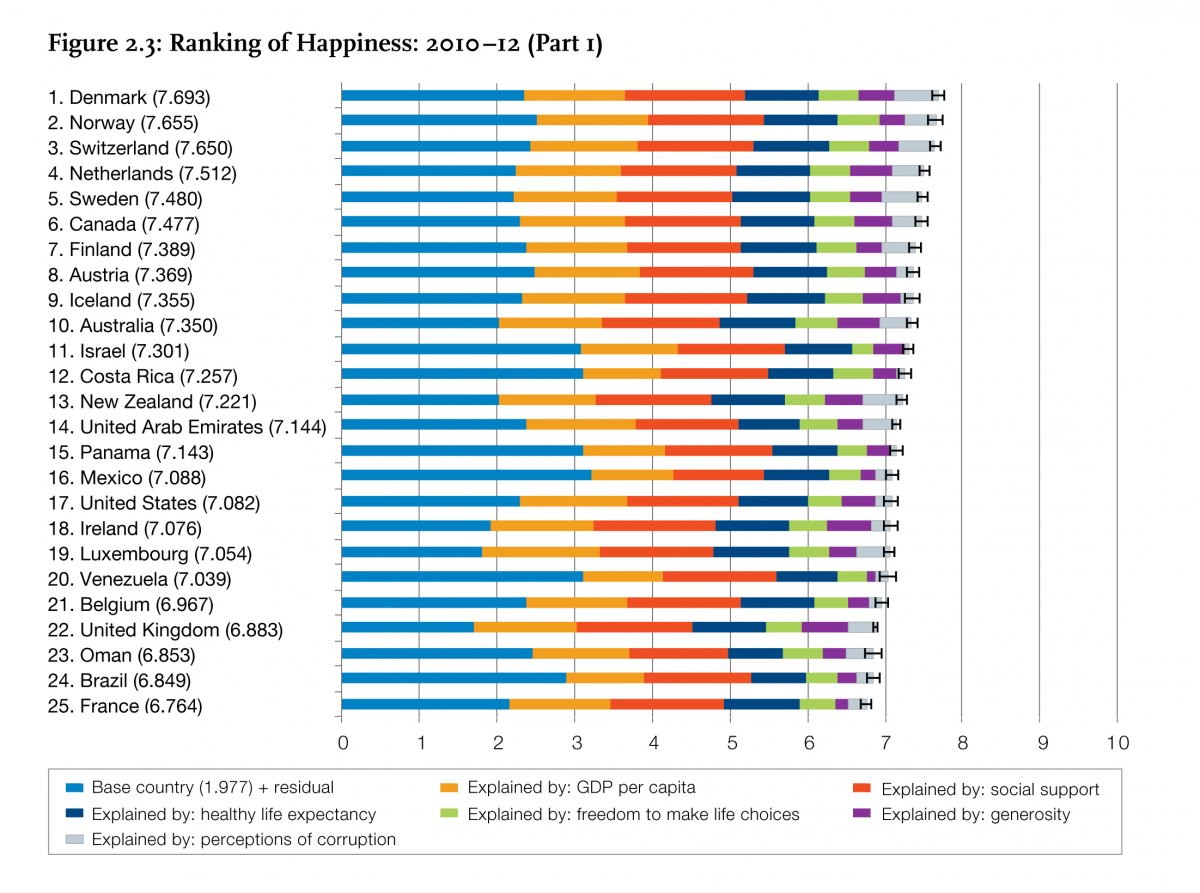
Happiness, once thought of as a subjective quality, is increasingly now subject to attempted objective quantification

But it is worth reflecting on what was lost in this philosophical revolution, and also on what some of its (largely unintended) consequences have been. Gone was a universe that might be understood in terms of spirits, of qualitatively different parts; the universe had been rationalized as working according to a set of unchanging and rigid scientific laws, as something that could be worked out by measuring and understanding the laws. It was perhaps inevitable that this approach, at first restricted in its application largely to an understanding of the natural world and the workings of the universe, would eventually be extended to almost everything: health, education, social conditions, the workplace, the economy are now routinely reduced to metrics and the quantifiable, with little regard paid to unquantifiable qualities (although even in respect of these attempts are made to ‘measure’ satisfaction, happiness, quality of life, and so on).

Descartes did not himself view the universe solely in material terms. Famously he set out arguments that, he believed, proved the existence of God; and he held to a dualist philosophy in which, just as the universe consisted of both matter subject to scientific laws and God, so humans were made up of a material body and an immaterial mind. But, however much they endeavoured to avoid a view on the universe as akin to a coldly rational machine, neither his proofs of God’s existence nor his dualism have ever been convincing. Indeed, my own suspicion is that his arguments for God’s existence and the immortality of the soul were decidedly secondary to his main concern of outlining a mechanistic philosophy. It was perhaps the implications of that mechanistic philosophy that compelled him to find ways of demonstrating that God and the spiritual nevertheless still have a place somewhere inside the universe: maybe he sensed the potentially bleak universe that may arise once all that is not quantifiable has been leeched out of it.

To blame Descartes for the modern obsession with metrics and the quantifiable, for the move away from the qualitative and the moral, and with the cult of novelty and originality would, of course, be unfair. Descartes could not foresee such things as the dominance of the scientific worldview. Even so, if we want to locate one of the roots of the modern political, economic, social and cultural malaise, then I suggest that the mechanical philosophy of Descartes is a good place to look.

On Descartes (I)

According to his own account, Descartes arrived at his philosophical breakthrough in a state of intense solitude. Heavy snow had confined him to a cabin, and it was there, with a few key props such as a fire and an armchair, that he followed his path of radical scepticism to its famous proposition of ‘I think therefore I am’, transforming philosophical inquiry for good.

raphael_school_of_athens

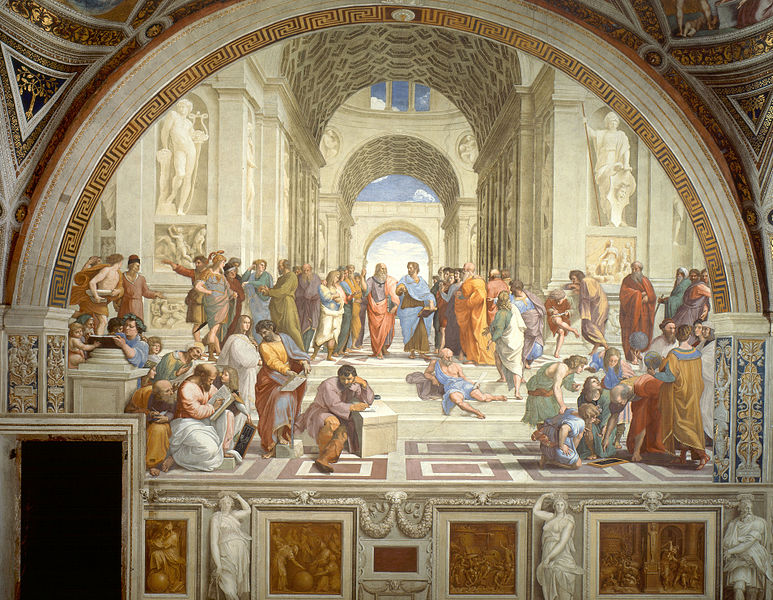
Raphael, The School of Athens, c.1510

Whatever its veracity, this story is profoundly interesting. Compare Descartes’ philosophizing with that of Socrates and Plato. Whereas the two ancient Athenians conducted their inquiries in a highly social way, through discussion, dialogue, a constant succession of questions and answers, Descartes eschews human company (indeed, his thought process involves him doubting that other humans even exist). Raphael’s famous painting of The School of Athens captures the buzzing, vibrantly social character of ancient Greek thought. Descartes’ Meditations could hardly be more different to this image: indeed, the very title of the work reflects the individualistic, meditational nature of Descartes’ philosophizing.

Historians of philosophy have long noted possible influences on Descartes’ approach. There are overtones of Augustine in various places—and hence we may speculate on resemblances with the meditational Confessions of the Church Father—and, more immediately, Descartes’ Jesuit schooling would have made him deeply familiar with the Spiritual Exercises of Loyola, a work stemming from Loyola’s own spiritual retreat. Perhaps, too, the spirituality of the late medieval devotio moderna, notably The Imitation of Christ by Thomas à Kempis (a work influential on Loyola’s spiritual conversion), may be identified as a precursor.

Descartes was certainly not exceptional in presenting a narrative of solitary, introspective, meditational thought. Indeed, he could be placed squarely within the spiritual tradition of Christianity, one that begins with the various stories of solitude and wilderness in the Bible, runs through the medieval mystical thinkers, and encompasses key religious figures as diverse as Loyola and Luther (whose famous theological breakthrough occurred, according to his own account, in his own state of reclusive confinement). The fact that the full title of Descartes’ Meditations states that the work proves the existence of God and the immortality of the soul suggests a conscious nod to this religious tradition, and perhaps even a wish that his treatise be placed within it.

Still, I think it significant that ‘modern philosophy’ (if we accept the common terminology of mainstream historiography of philosophy) should emerge out of a story of solitude. It is, of course, only a story, and it would be far too simple-minded to take it at face value—however much he liked to obscure its origins, Descartes’ philosophy arose from far more than the daily meditations of a solitary man in an armchair by a fire. But even if only a myth, like all myths it nevertheless asserts several ‘truths’: the value of the individual, the virtue of solitude, and the need to pursue understanding far from the crowd. These ‘truths’ are not uncontentious, and they do not necessarily have happy outcomes (individualism and solitude are not unalloyed goods). All the same, in an age in which those of us drawn towards introspection, solitude, quiet reflection and a refusal to conform to social conventions and norms are increasingly regarded with suspicion and even hostility, Descartes’ narrative of his own philosophical journey is reassuringly welcome.

And as we are urged and cajoled to rise early each day, to be busy and industrious in the world, we might note that Descartes’ practice was to lie in bed thinking until late in the morning. But even Descartes could not fully resist the demands of the world: accepting the position of court philosopher to Queen Christina of Sweden, he died only a few months after taking up the post, the rigours of rising in the very early hours to tutor the queen unsurprisingly taking their toll.

Solitude (I)

‘Our language has wisely sensed… two sides of man’s being alone. It has created the word “loneliness” to express the pain of being alone. And it has created the word “solitude” to express the glory of being alone.’ (Paul Tillich, The Eternal Now, 1963)

remote_cottage

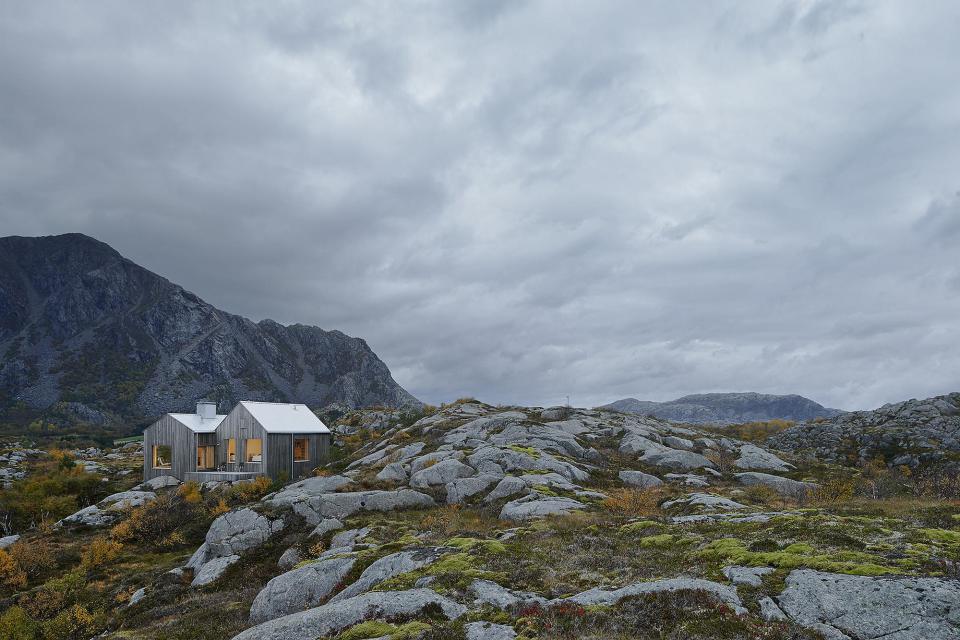
That looks very appealing…

I have a recurring fantasy of heading off somewhere remote to live alone, far removed from human society. The experience might well drive me to the psychological edge—perhaps even beyond it. But I am intrigued by the idea, by what I might learn about myself and about the universe.

Little of this fantasy is defined. Usually it consists of a simple dwelling, warm and cosy, filled with my books, surrounded perhaps by rolling hills, green views and some wild weather. All I need is warmth, shelter, a comfortable bed, basic facilities for washing and cooking, a means of writing, and my books and music. I can understand that not everyone would find that enough. But I struggle to grasp why anyone needs much more than that. Why all the gadgets, the spare rooms, the extra cars, the superfluous furniture, the stuffed wardrobes? Sometimes I wonder if my lack of desire for this abundance is at the root of my problems. I have never felt the need for all this, and so have never been inclined towards striving and ambition. But it’s clearly no good just living life in a simple way. Those of us who do not want to play the game of competition and ambition are forced to be part of it—but by not bothering to play, we lose.

So my fantasy is in part about wishing to escape the senseless game we find ourselves in. But it involves more than a negative opting out of society. Solitude, for me, is a positive choice. Even in my present life in the city I often willingly go for days without any human contact, not because I am antisocial but because I crave solitude. Others frequently interpret this as a rejection, but it really is no such thing. I genuinely enjoy my time with other people, but I can only manage it in small doses. I worry far more about the psychological damage of constant society than I do about the risks of constant solitude. To have plenty of time on my own—and I mean long stretches of days and days—is a deep need in me.

For how can we truly reflect if we are always immersed in the noises and demands of society? Of course there is much that we can learn only from other people—I have been a student and teacher, I have felt the value of discussion and the classroom, and many times the pub—but some things can only be accessed away from all that, by going deep into one’s self, by the solitary experience of the wilderness. Not everyone is curious about what might be learnt there; but for those of us who are, I cannot see any other way than through solitude.

So increasingly I feel the urge to figure out a way of doing this. Perhaps my reclusive tendency is a sign that I am already doing it. But I am not convinced that my current way of living is enough. Often I fall asleep imagining that I am nestled far away, where time and society no longer rule, where I would be undisturbed from reading, listening to music, walking, smoking, thinking and writing.

But for now I content myself with re-reading Sara Maitland’s A Book of Silence (2008), a wonderful exploration of silence and solitude (her 2014 book How to be Alone is also well worth reading), and, inspired by Maitland, Bernard Moitessier’s The Long Way (1973), a beautiful, frequently meditational, account of his solo sailing voyage around the world. As so often, books and reading fill the gaps in my life.